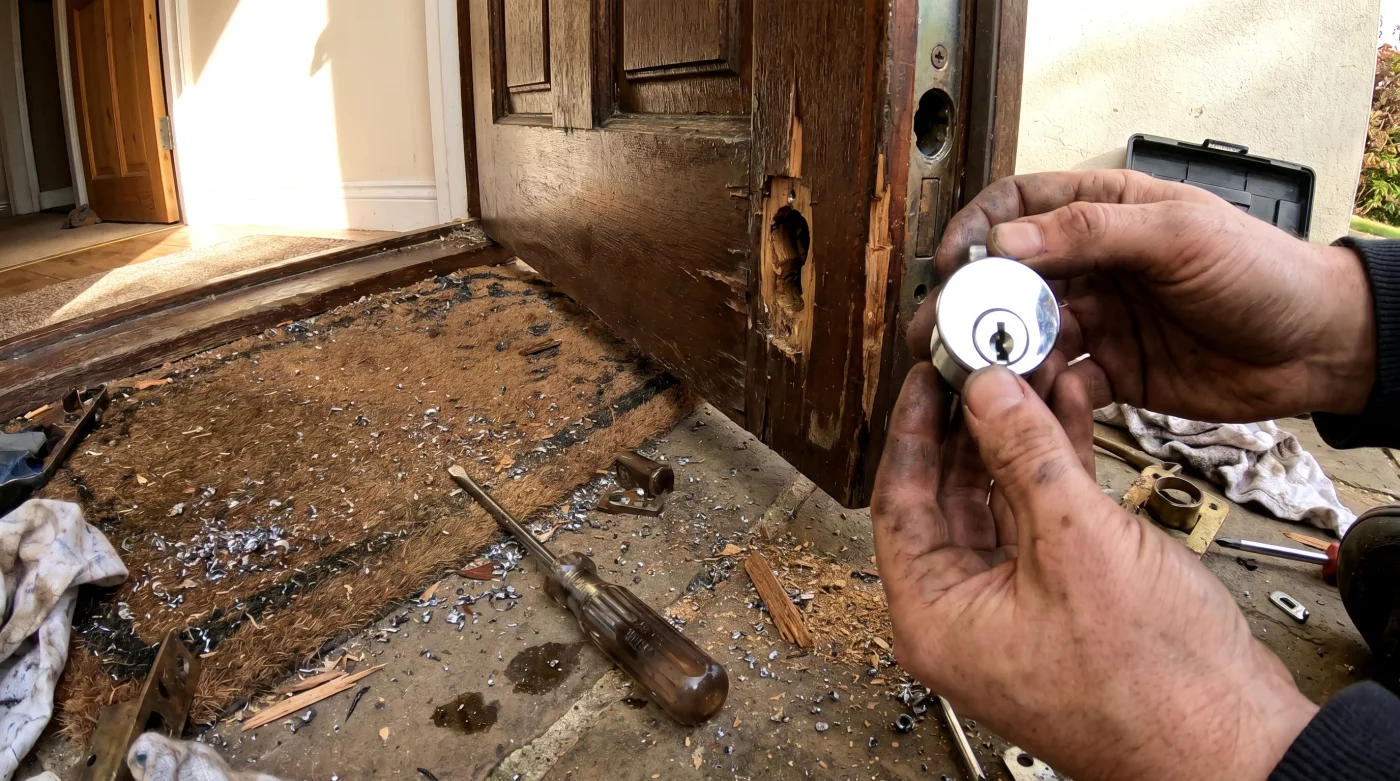
You stand back on a crisp October afternoon, wiping sawdust from your jeans. The heavy brass of your brand-new cylinder lock catches the fading light. It feels solid, uncompromising, and incredibly secure. You turn the key, listening to that heavy, satisfying thud as the bolt slides home into the doorframe.
You sleep soundly tonight, convinced that this £200 weekend upgrade has fortified your home against the outside world. It seems like pure common sense: a thicker, newer, shinier mechanism must naturally repel trouble and impress your insurance provider.
But an unsettling reality sits just beneath that polished surface. Rather than cementing your safety, you might have just handed your insurer the exact loophole they need to tear up your policy. The mechanism might be heavy, but if it lacks a specific, almost invisible engraving, you are entirely exposed.
This is the depreciation trap—spending hard-earned pounds on a premium security feature that inadvertently strips away your financial safety net. A minor DIY triumph suddenly morphs into a devastating liability.
The Illusion of Heavy Metal
Let us reconsider how a door actually works. Think of your front door less as a physical barrier and more as a legal contract hanging on hinges. When you take out home cover, that paperwork assumes a baseline level of structural resistance.
We instinctively trust weight, assuming that a thick chunk of steel equates to impenetrable safety. But insurers do not deal in feelings or aesthetic bulk; they deal in standardised testing and certified failure points. They want proof that a lock can withstand a determined attack for a precise number of minutes.
Buying an imported, high-tech lock without the required British Standard certification—specifically the BS 3621 Kitemark for timber doors, or TS007 for uPVC—is like buying an expensive sports car with paper brakes. The moment a burglar snaps that uncertified cylinder, your insurer checks the wreckage. If they do not see the Kitemark, they walk away, leaving you to foot the bill for the stolen laptops and shattered frame.
Consider Martin, a 54-year-old master locksmith operating out of Sheffield. Last winter, he was called to a terraced house where the homeowner had proudly installed a heavily advertised, imported smart lock. “It looked like something from a spaceship,” Martin recalled, shaking his head. “But they had removed a BS 3621 five-lever mortice to fit it. When the place was burgled via a simple crowbar attack, the insurer refused the £12,000 claim because the new tech had not been tested to British Standards. The homeowner paid top dollar to void their own policy.”
Adjusting for Your Architecture
Not all doors bear the same burdens. How you approach this hidden insurance trap depends entirely on the material hanging in your porch.
For the Timber Traditionalist. If you live in a Victorian terrace or a cottage with a solid wood door, your insurer almost certainly demands a five-lever mortice deadlock conforming to BS 3621. This means the lock has been rigorously tested against drilling and picking. If you swap it for a standard sashlock from the local hardware shop, your cover evaporates.
For the uPVC Modernist. Modern composite or uPVC doors rely on Euro cylinder locks. These are notoriously vulnerable to a technique called lock snapping. Your paperwork likely insists on a 3-star TS007 Kitemark cylinder, or a 1-star cylinder paired with 2-star security handles. Ignore this, and that pristine white door is a welcome mat for opportunists.
For the Smart Home Pioneer. Keyless entry is wonderfully convenient when your hands are full of shopping bags. However, many flashy imported devices lack British certification. If you want biometric or keypad entry, you must hunt down smart locks that explicitly boast the BSI IoT Kitemark or meet TS621 standards.
The Kitemark Audit
You do not need to wait for a disaster to discover your standing. You can evaluate your legal and physical security right now, using nothing but a torch and a mindful eye.
Take a quiet moment tonight to step into your hallway. Open the door and look closely at the metal faceplate set into the edge of the wood, or examine the circular face of your cylinder.
- Locate the stamp: Hunt for a small, heart-shaped engraving with an ‘S’ and a ‘B’ nested inside it.
- Check the code: Below or beside this heart, you need to read ‘BS 3621’ for mortice locks or spot a three-star rating for Euro cylinders.
- Photograph the evidence: Keep a clear, timestamped photo of this mark on your phone.
- Call your broker: If you cannot find the mark, ring your provider immediately to clarify their exact wording regarding minimum security requirements.
Your tactical toolkit here is minimal: a microfibre cloth to wipe away years of grime from the faceplate, the flashlight on your phone to illuminate the tiny stamped digits, and five minutes of focused attention.
Peace of Mind in a Tiny Stamped Heart
True security is never loud. It does not need to beep, flash, or weigh twenty pounds to keep the outside world at bay. We often fall into the trap of confusing complexity with safety, throwing money at shiny upgrades while accidentally dismantling our safety nets.
Finding that tiny, heart-shaped Kitemark on your door edge does more than appease an underwriter sitting in a distant office. It anchors you. It means that when you turn the key, pull the handle, and listen to the house settle for the night, you are genuinely protected. You can sleep knowing that both the wood in the frame and the paper in the filing cabinet are working in perfect harmony.
“A heavy door without a Kitemark is just a very expensive piece of firewood waiting to fail.”
| Lock Type | BS Requirement | Added Value for the Reader |
|---|---|---|
| Timber Doors (Mortice) | BS 3621 | Ensures resistance to drilling and picking, keeping standard insurance valid. |
| uPVC/Composite (Euro Cylinder) | TS007 (3-Star) | Prevents lock-snapping attacks, the most common entry method in the UK. |
| Smart Locks | TS621 / BSI IoT | Combines digital convenience with underwriter-approved physical toughness. |
Frequent Clarifications
Does a 3-lever lock void my insurance? Yes, most standard policies specifically require a 5-lever lock conforming to BS 3621 for external timber doors.
Can I add a nightlatch to compensate? A nightlatch can help, but if it is the only lock, it must meet BS 3621 or BS 8621 to satisfy typical insurance clauses.
Will a locksmith know what my insurer needs? A certified master locksmith will know the BSI standards, but you must read your specific policy schedule to confirm the wording.
Do window locks matter as much as the front door? Absolutely. Key-operated locks on all accessible ground-floor windows are a standard policy requirement alongside your door security.
What if I rent my property? Landlords are legally obliged to provide a secure home, but as the tenant buying contents insurance, your policy still demands these minimum standards.